Discover Premium Ceramic Products | Durability & Elegance United | Advanced Ceramics

1. Introduction
Just 24 hours ago, a major materials supplier announced a breakthrough in sintered silicon carbide (SiC) production that reduces porosity by 18%—a development poised to significantly extend the lifespan of silicon carbide crucibles in foundries and semiconductor labs. This innovation highlights the ongoing evolution of advanced ceramics in extreme environments.
While many associate ‘silicon carbide’ only with abrasives or car brakes, its role in high-temperature containment—especially via the silicon carbide crucible—is foundational across metallurgy, glassmaking, and lab-scale crystal growth. But how does it truly stack up against its cousin, silicon nitride? And why are terms like ‘silicon carbide ceramic baking dish’ or ‘silicon carbide tube’ flooding e-commerce sites?
2. Material Fundamentals: Silicon Carbide vs. Silicon Nitride
2.1. Silicon Carbide Properties
Silicon carbide (SiC) is renowned for its exceptional hardness (9.5 on the Mohs scale), thermal conductivity (~120 W/m·K), and resistance to thermal shock. These traits make the silicon carbide crucible ideal for melting non-ferrous metals like aluminum, copper, and zinc at temperatures exceeding 1,600°C.
Its covalent bonding structure grants chemical inertness, preventing contamination during reactive metal processing. However, pure SiC can oxidize above 1,400°C in air unless protected by coatings or sintering additives.
2.2. Silicon Nitride Advantages
Silicon nitride (Si3N4), while less thermally conductive than SiC, offers superior fracture toughness and better resistance to oxidation at very high temperatures. This makes silicon nitride crucibles—often produced by specialized silicon nitride crucible factories—preferred in applications involving repeated thermal cycling or where mechanical impact is a concern.
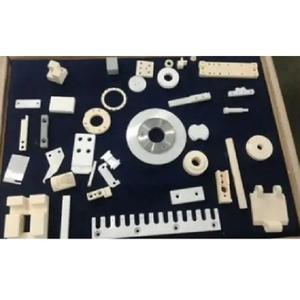
Silicon nitride ceramic components like custom silicon nitride heat shields, silicon nitride rings, and silicon nitride plates are increasingly used in aerospace and turbine engines due to their creep resistance.
3. Crucible Comparison: Performance in Practice
3.1. Thermal Shock Resistance
Silicon carbide crucibles outperform most alternatives in rapid heating/cooling scenarios. Their high thermal conductivity dissipates heat evenly, minimizing stress cracks—a critical factor in continuous casting operations.
In contrast, silicon nitride crucibles absorb thermal gradients more gradually, which can be advantageous in precision lab settings but less so in high-throughput foundries.
3.2. Chemical Compatibility
For melting reactive alloys (e.g., titanium or rare earths), silicon nitride may offer better compatibility due to lower reactivity with certain slags. However, for standard non-ferrous work, silicon carbide remains the industry default.
Notably, boron carbide vs silicon carbide debates often arise in armor applications, but boron carbide is rarely used in crucibles due to cost and fabrication challenges.
4. Beyond Crucibles: The Expanding Universe of SiC Ceramics
4.1. Industrial Components
The same material science behind the silicon carbide crucible powers other high-performance parts:
- rbsic silicon carbide tile blocks for kiln linings
- silicon carbide burner nozzles resistant to flame erosion
- silicon carbide bricks for furnace walls
- silicon carbide thermocouple protection tubes and porous ceramic tubes for gas filtration
- silicon carbide ceramic pipes and tubes for corrosive fluid handling, including silicon carbide mullite tubes for hybrid durability
These leverage SiC’s stability in aggressive chemical and thermal environments.
4.2. Consumer & Artisanal Applications
Surprisingly, ‘silicon carbide ceramic dinnerware’ has gained traction online. Search results now include ‘silicon carbide white ceramic plates,’ ‘silicon carbide black ceramic plates,’ ‘silicon carbide ceramic casserole dish with lid,’ and even ‘silicon carbide ceramic childrens plates.’
However, most of these products are mislabeled. True silicon carbide is black, extremely hard, and not food-safe in raw form. What’s sold as ‘silicon carbide baking dish staub’ or ‘silicon carbide ceramic pie dish’ is typically stoneware or porcelain with SiC-inspired aesthetics—not actual SiC content.
Genuine silicon carbide ceramic baking dishes would be prohibitively expensive and unnecessary for home ovens. The keyword proliferation appears driven more by SEO than material reality.
5. Discs, Tubes, and Niche Forms
Silicon carbide discs—whether grinding, sanding, or piezoelectric—are legitimate industrial items. Silicon carbide diamond grinding discs for pottery and silicon carbide ceramic disc taps (used in plumbing for wear resistance) are well-established.
Similarly, silicon carbide ceramic tubes serve vital roles: from furnace insulation to thermocouple sheaths. High-purity variants support semiconductor manufacturing, where even trace impurities ruin wafer batches.
6. Market and Manufacturing Trends
The high purity silicon nitride powder market is growing at 7.2% CAGR, driven by EV and 5G demands. Meanwhile, silicon carbide production scales with electric vehicle inverters and solar furnaces—indirectly benefiting crucible availability.
Customization is rising: manufacturers now offer tailored silicon carbide ring geometries, silicon carbide ceramic columns for filtration, and bespoke crucible shapes for lab-scale crystal growers.
7. Conclusion
The silicon carbide crucible remains unmatched for high-thermal-conductivity, high-wear melting applications. Silicon nitride fills complementary niches where toughness and oxidation resistance trump raw heat transfer. While consumer markets misuse ‘silicon carbide’ as a buzzword for dinnerware, the real engineering value lies in industrial ceramics—from tubes to tiles to thermocouple shields. As sintering tech advances, expect both materials to push further into extreme-environment applications.
Our Website founded on October 17, 2012, is a high-tech enterprise committed to the research and development, production, processing, sales and technical services of ceramic relative materials such as Silicon. Our products includes but not limited to Boron Carbide Ceramic Products, Boron Nitride Ceramic Products, Silicon Carbide Ceramic Products, Silicon Nitride Ceramic Products, Zirconium Dioxide Ceramic Products, etc. If you are interested, please feel free to contact us.
RELATED POSTS
Silicon Carbide Crucibles Power Next-Generation Semiconductor Crystal Growth
