Discover Premium Ceramic Products | Durability & Elegance United | Advanced Ceramics

1. Introduction
In a major development just 24 hours ago, the U.S. Department of Energy announced a $120 million investment into advanced nuclear recycling technologies, specifically targeting molten salt electrorefining systems that rely on high-performance containment materials. At the heart of these next-generation reactors? The silicon carbide crucible—a rugged, heat-resistant vessel capable of withstanding temperatures above 1600°C while resisting corrosion from aggressive fluoride and chloride salts used in spent nuclear fuel processing.
While many associate ‘silicon carbide‘ with kitchenware like silicon carbide ceramic dinner plates or baking dishes, its industrial-grade form is indispensable in fields where failure is not an option. This article dives into one of its most demanding—and least publicized—applications: nuclear fuel recycling.
2. Why Silicon Carbide Crucibles Excel in Nuclear Reprocessing
Nuclear fuel reprocessing involves dissolving spent uranium or plutonium fuel in high-temperature molten salts to recover usable actinides. The chemical environment is extraordinarily corrosive, and conventional metals or oxides degrade rapidly. Enter the silicon carbide crucible.
Silicon carbide offers exceptional thermal conductivity, low thermal expansion, and outstanding resistance to both oxidation and chemical attack—even in halide-rich melts. Unlike graphite crucibles, which can react with molten salts and introduce carbon impurities, silicon carbide remains chemically inert under these conditions.
- High purity silicon carbide maintains structural integrity up to 1800°C in inert atmospheres
- Its covalent bonding structure prevents ion diffusion, minimizing contamination of recycled fuel
- Compared to alternatives like alumina or zirconia, silicon carbide exhibits far superior thermal shock resistance

3. Boron Carbide vs Silicon Carbide: A Misguided Comparison in This Context
You might see comparisons like ‘boron carbide vs silicon carbide’ online, often in armor or abrasive contexts. But in nuclear crucible applications, boron carbide is rarely suitable. While it has a higher neutron absorption cross-section (useful in control rods), it’s prone to swelling and decomposition in molten salt environments above 800°C. Silicon carbide, by contrast, remains dimensionally stable and corrosion-resistant well beyond that threshold.
Moreover, boron carbide can release volatile boron species that contaminate the fuel stream—unacceptable in closed-loop recycling systems. Thus, for crucibles in electrorefining cells, silicon carbide is the clear winner.
4. Silicon Nitride Isn’t the Answer Here—Despite Its Strengths
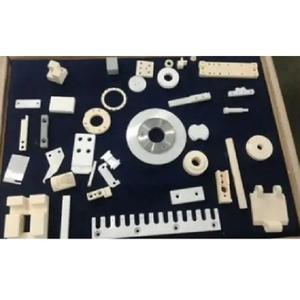
Silicon nitride ceramic components—such as silicon nitride rings, plates, or custom heat shields—are excellent for turbine blades, bearings, and semiconductor fixtures thanks to their toughness and creep resistance. However, they hydrolyze in the presence of moisture and degrade in molten chlorides or fluorides, making them unsuitable for nuclear salt baths.
Even a high purity silicon nitride powder market surge won’t change this fundamental limitation. While a silicon nitride crucible factory might produce vessels for lab-scale oxide melting, they simply can’t match silicon carbide’s stability in aggressive halide melts used in fuel recycling.
5. Debunking the Dinnerware Distraction
A quick online search reveals countless listings for ‘silicon carbide ceramic baking dish’, ‘silicon carbide dinner ceramic plates’, or even ‘silicon carbide ceramic butter dish’. These are marketing terms—often misapplied. True silicon carbide is black, extremely hard, and not food-safe in raw form. Most ‘silicon carbide’ cookware is actually glazed stoneware or porcelain with no actual SiC content.
Genuine silicon carbide ceramics used industrially—like rbsic silicon carbide tile blocks, silicon carbide burner nozzles, or silicon carbide thermocouple protection tubes—are engineered for performance, not aesthetics. Confusing kitchenware with nuclear-grade materials risks underestimating the material’s real engineering value.
6. Supporting Components: Beyond the Crucible
The success of silicon carbide crucibles in nuclear systems relies on compatible infrastructure. That includes:
- Silicon carbide ceramic tubes for furnace atmospheres
- Silicon carbide porous ceramic tubes for gas filtration in off-gas systems
- Silicon carbide discs used as insulating spacers in electrode assemblies
Even silicon carbide ceramic piping may be employed in secondary coolant loops due to its erosion resistance. Every component must meet stringent purity standards to avoid introducing trace metals that could poison the recycling chemistry.
7. Conclusion
As nations race to close the nuclear fuel cycle and minimize long-lived waste, the humble silicon carbide crucible emerges as a silent enabler of sustainable atomic energy. Far removed from the world of ceramic salad bowls or Christmas plates, this advanced material operates in one of the most hostile industrial environments on Earth—and thrives. With new government funding accelerating deployment, expect silicon carbide crucibles to play an even larger role in the clean energy transition.
Our Website founded on October 17, 2012, is a high-tech enterprise committed to the research and development, production, processing, sales and technical services of ceramic relative materials such as Silicon. Our products includes but not limited to Boron Carbide Ceramic Products, Boron Nitride Ceramic Products, Silicon Carbide Ceramic Products, Silicon Nitride Ceramic Products, Zirconium Dioxide Ceramic Products, etc. If you are interested, please feel free to contact us.